
Tetris Online, Played in This Tab
On a phone, turn sideways or use the pad. Everything here is drawn in this tab.
SCORE0
LINES0
LEVEL1
BEST0
NEXT
- ←→ move
- ↑ rotate
- ↓ soft drop
- Space drop
- P pause
- R restart
| Input | Action |
|---|---|
| Left / right arrows (or A / D): slide the shape one column. | |
| Up arrow, X, or the round button: rotate clockwise. Z rotates the other way. | |
| Down arrow: soft drop one row. Space: hard drop straight to the bottom. | |
| P pauses, R restarts. On a phone the pad under the board does all of it. | |
| Scoring, speed and what counts as a line are in the README below. | |
TETRIS
ARCADE · WRITTEN FOR THIS SITE
READY
- TITLE
- Tetris
- BUILD
- Original code written for this site
- BOARD
- 10 columns x 20 rows
- SAVED
- Best score stays in this browser
Who made this
This game is written and drawn for Doshaven; it is not a re-release of the 1980s coin-op. No original artwork, sound or code is used, and nothing is loaded from a third party when you press play.
What loads
Nothing downloads. The page itself is the game: a canvas, a few hundred lines of script, and the keyboard or the pad below it.
C:\> TYPE README.TXT
How to play
What it is
Tetris is the falling-shape puzzle: ten columns, seven shapes, and a row that vanishes the moment it is full. This version is written for this site and runs inside the page — arrows and space on a desktop, the pad on a phone, no download and no account. Press START and the first shape begins to fall.
What you are playing
A ten by twenty board, one falling shape at a time. A shape slides sideways, rotates in quarter turns, and drops. When it lands it stays. Fill every column of one row and that row disappears, everything above drops down a step, and you get points. Stack the pieces until a new shape cannot enter at the top and the run is over. Speed is fixed by the level: the board starts slow, and every ten cleared lines makes the pieces fall one step faster, up to a floor where it stops getting quicker.
Scoring, in plain numbers
Clearing one row is 100 points, two rows 300, three rows 500 and four rows at once 800 — and every one of those numbers is multiplied by the current level, so a four-line clear at level three pays 2,400. Dropping a piece with the down arrow adds one point per row it travels; the instant drop adds two points per row. Your best score is written into this browser's local storage on this device, so it survives a reload and is never sent anywhere.
The seven shapes
There are seven pieces and they are defined by geometry, not by a licensed skin: the long bar of four, the two mirror-image L shapes, the square, and the three five-cell shapes that look like an S, a Z and a T. Each cycle deals all seven in a shuffled order before any one of them can repeat, which is why a run rarely feels like the same piece twice in a row. The blocks, the colours and the grid are drawn for this site with the page canvas; no sprite, tile sheet or sound from any commercial release is loaded.
Why there is no music, and no official look
Older falling-block games shipped with their own artwork, palettes and soundtracks, and that material is still owned by its publishers. Serving it, or copying it closely, would be a copyright problem for a small site. So this build uses its own seven-tone palette on the same near-black background as the rest of Doshaven, and it stays silent. The rules are not the protected part — the look and the sound are — so the rules are kept and the look is ours.
How to get better at it
Keep the stack low and flat. A flat surface gives every shape somewhere to land, and a staircase of one-cell pits is what ends most runs. Leave a single column open on one side so the long bar can clear four rows at once — it is worth more than four separate clears and it buys you time. Read the next-piece panel before you drop, not after. On the higher levels, line up the landing spot with the hard drop rather than nudging a piece down one row at a time; the extra points are small but the seconds you save are not.
Where the idea comes from
The falling-block puzzle was written by Alexey Pajitnov in 1984 on an Electronika 60 computer in Moscow, and it spread from there onto almost every machine that followed, including the DOS PCs this site is built around. The version on this page is an independent implementation of those rules, not a port of any existing release: no original code, art or audio is used, and nothing is emulated. Tetris is a trademark of The Tetris Company; the name appears here only to say what kind of game this is.
C:\> TYPE FAQ.TXT
FAQ
Is this the official Tetris?
No. This is an independent falling-block puzzle built for Doshaven with its own code and colours. Tetris is a trademark of The Tetris Company, and the name is used here only to describe the kind of game it is.
Do I have to download or install anything?
No. The game is part of the page: press START and it runs in the tab. There is no plugin, no emulator and no account.
Does it work on a phone?
Yes. The pad under the board gives you left, right, rotate, soft drop, hard drop and pause. Landscape gives the board more height to work with.
How is the score calculated?
One row is 100, two 300, three 500 and four 800, multiplied by the level. A soft drop adds a point per row, a hard drop two. Speed rises every ten lines.
Does it save my best score?
The best score is stored in this browser on this device and shown in the BEST field. Nothing is uploaded and there is no account to make.
Can I see the next shape before it arrives?
Yes, the NEXT panel shows the following piece. Each cycle deals all seven shapes in a shuffled order before repeating one.
C:\> DIR /GAMES
More games
Same lane, one click away. Every card is a page with a game that runs in this tab.-
 ORIGINAL
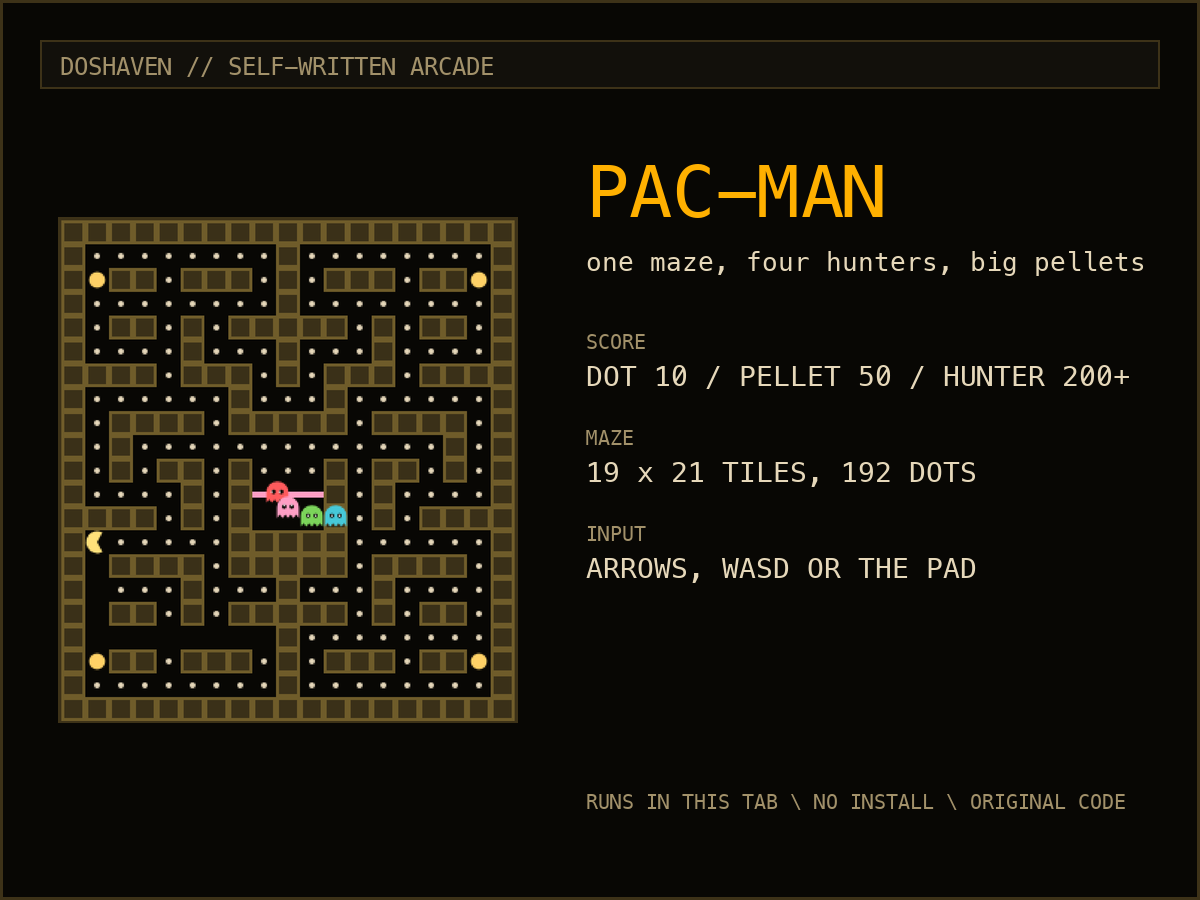
Pac-Man The other arcade shape here: a maze, four hunters, one pellet at a time. Original code · runs in this tab
-
 FREEDOOM
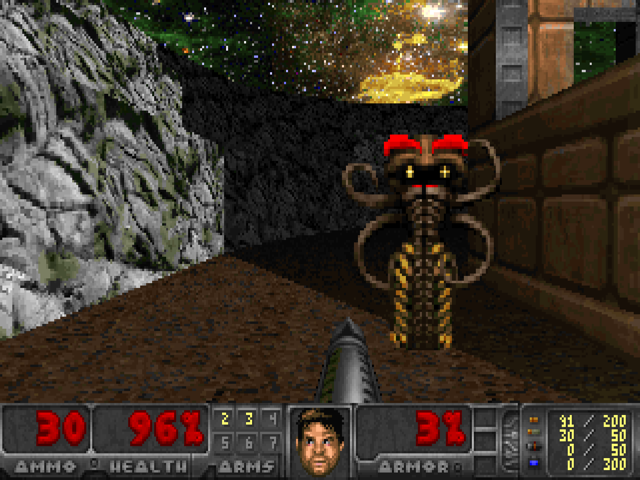
Doom Browser Doom-family play in the tab, free data included. Freedoom Phase 1 · BSD 3-Clause
-
 FREEWARE
Tyrian The complete freeware Tyrian 2.1: waves and a weapon shop. Tyrian 2.1 · 2004 freeware release
-
 OPEN SOURCE
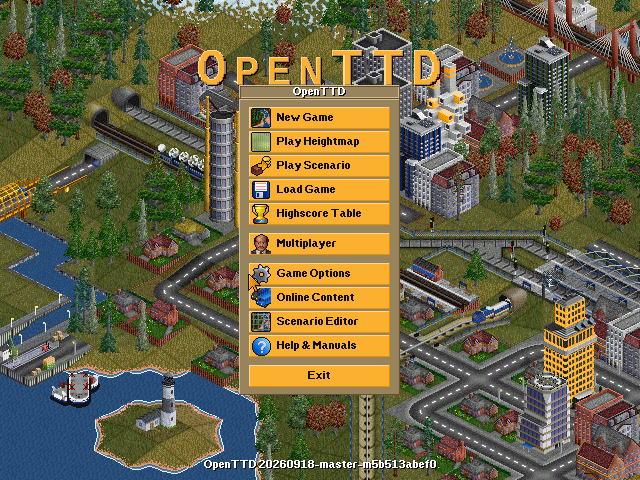
OpenTTD When you want depth instead of a quick round. OpenGFX / OpenSFX / OpenMSX · GPL
-
The Legend of Kage BYO FILEThe Legend of Kage Taito's 1985 ninja game — our emulator, your own NES file. EmulatorJS 4.2.3 · GPL-3.0
-
 SHAREWARE
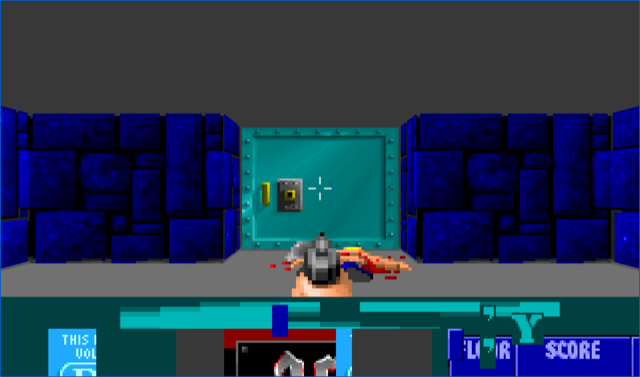
Wolfenstein 3D Numbered floors, treasure and a score, 1992 shareware. Apogee 1992 shareware · Episode 1
C:\> DIR /GAMES /NEW
New on the shelf
Recently added. Every card is a page with a game that runs in this tab.-
ARCHIVE
SkiFree Down a slope of trees and rocks, past the monster that wakes at 2,000 metres. The 1991 Windows ski game. Runs from the Internet Archive · nothing hosted here -
ARCHIVE
Digger Dig tunnels, grab the emeralds and drop gold bags on the Nobbins: Windmill Software's 1983 IBM PC classic. Runs from the Internet Archive · nothing hosted here -
ARCHIVE
Alley Cat Jump the fence, dodge the dog and the broom, and clear the rooms of a strange house: Bill Williams' 1984 IBM PC classic. Runs from the Internet Archive · nothing hosted here -
ARCHIVE
The Oregon Trail Buy the oxen, watch the rations, ford the rivers and hope nobody gets dysentery: MECC's 1992 Deluxe edition. Runs from the Internet Archive · nothing hosted here -
SHAREWARE
Raptor: Call of the Shadows Nine missions of air and ground targets, a boss to bring down, and money for weapons between waves. Apogee's 1994 shooter. Runs from the Internet Archive · nothing hosted here -
SHAREWARE
Jill of the Jungle Run, jump and swing a dagger through forests and caves, and turn into a bird, a fish or a frog. Epic MegaGames' 1992 platform game. Runs from the Internet Archive · nothing hosted here -
FREEWARE
One Must Fall 2097 Pilots in giant robots fight one on one, with special moves and prize money for upgrades. The 1994 DOS fighting game. Runs from the Internet Archive · nothing hosted here -
SHAREWARE
Bio Menace Snake Logan shoots through a city of mutants in a platform game built on the Keen engine. Apogee's 1993 shareware episode. Runs from the Internet Archive · nothing hosted here -
SHAREWARE
Commander Keen in Keen Dreams Keen throws flower pellets at an army of vegetables in id Software's lost 1991 episode, in its 1992 shareware release. Runs from the Internet Archive · nothing hosted here
The whole shelf, sorted by type: the retro arcade hub · the catalog on the homepage.
If you came for the DOS-era corridor shooters instead, start with Doom Browser, or look at the other maze game on the site, Pac-Man.
C:\> TYPE COMMENTS.TXT